EMI / EMC / RFI Probes and Sensors
up to 6 GHz
Medium Loop EMC Probe
Small Loop EMC Probe
Large Loop EMC Probe
Electric Field Probe
100 Series EMC Probes
EMC-100A
Magnetic Field Probe
Medium-size loop 
0.50" tip diameter
$95.

Click for larger image
EMC-100B
Magnetic Field Probe
Small-size loop 
0.25" tip diameter
$95.
In stock
EMC-100C
Magnetic Field Probe
Large-size loop 
1.0"  tip diameter
$95.
In stock
EMC-100D
Electric Field Probe
Stub 
0.08"  tip diameter
$95.
In stock
EMC-101A Probe Set
Includes one each of
the above 4 probes
$295.

SMA-Adapter
Converts probe to
SMA(f) output
$19.
In stock
BNC-Adapter
Converts probe to
BNC(f) output
(not recommended >1 GHz)
$19.
In stock
SMB to SMA adapter
SMA to BNC adapter
add_to_cart.gif
add_to_cart.gif
add_to_cart.gif
add_to_cart.gif
view_cart.gif
add_to_cart.gif
add_to_cart.gif
add_to_cart.gif
These calibrated EMC probes, electromagnetic sensors, and pre-amplifier are ideal for finding  electromagnetic interference (EMI),  radio frequency interference (RFI), microwave emissions, identifying and fixing EMI / EMC / RFI emissions.
The loop probes (EMC-110A,B,C) are sensitive to magnetic fields. They have integrated electrostatic shields, providing isolation from common-mode signals, so these probes provide excellent repeatability.

The various loop sizes allow selection of the optimum probe for a given frequency. The smallest loop size has the best high-frequency response and spacial resolution but lower sensitivity.  The larger loop has greater sensitivity but lower frequency response and spacial resolution.

The probe tips are only 0.11"(2.8 mm)  thick, allowing the probe to be inserted into seams and gaps.
The EMC-100D is a stub probe, sensitive to electric fields. With its 0.08" wide tip, it offers the highest spatial resolution. It is ideally suited to tasks such as tracking sources down to the individual pins of an IC. It does not provide common mode rejection , hence the EMC-100D sensitivity can change due to the user's grip on the probe or cable.
The EMC-101A set includes one of each probe model.
The above probes have built-in SMB male connectors, so these Adapters can convert to SMA or BNC connector type.
Applications
Finding sources of EMI/EMC/RFI emissions problems.  Radiating susceptible circuits to find pickup points.
Noninvasive probing of RF circuits or PC boards, for example oscillator frequency, sidebands, phase noise.
Probe Features
Probes are passive, they require a display instrument (spectrum analyzer, power meter, or oscilloscope) 
with 50-ohm input impedance to display  the power received from the probe.
Probes are single-axis so they respond to fields orthogonal to the loop or parallel to the stub.
Integrated electrostatic shield in the loop probes eliminates common-mode pickup.
Multiple loop sizes offer optimum sensitivity and spatial resolution at different frequencies.
Probe dimensions optimized for access to tight spaces.
Calibrated sensitivity up to 3 GHz, depending on model. Usable to beyond 6 GHz.
Can be driven by a signal source to generate fields for electromagnetic susceptibility testing.
Minimum measurable field and resolution depends on your display instrument, and on pre-amplifier (see below).
No battery or power supply needed for the probe.
Warranty:  30 day unconditional return policy. 1 year warranty.
Frequency Response and Sensitivity:
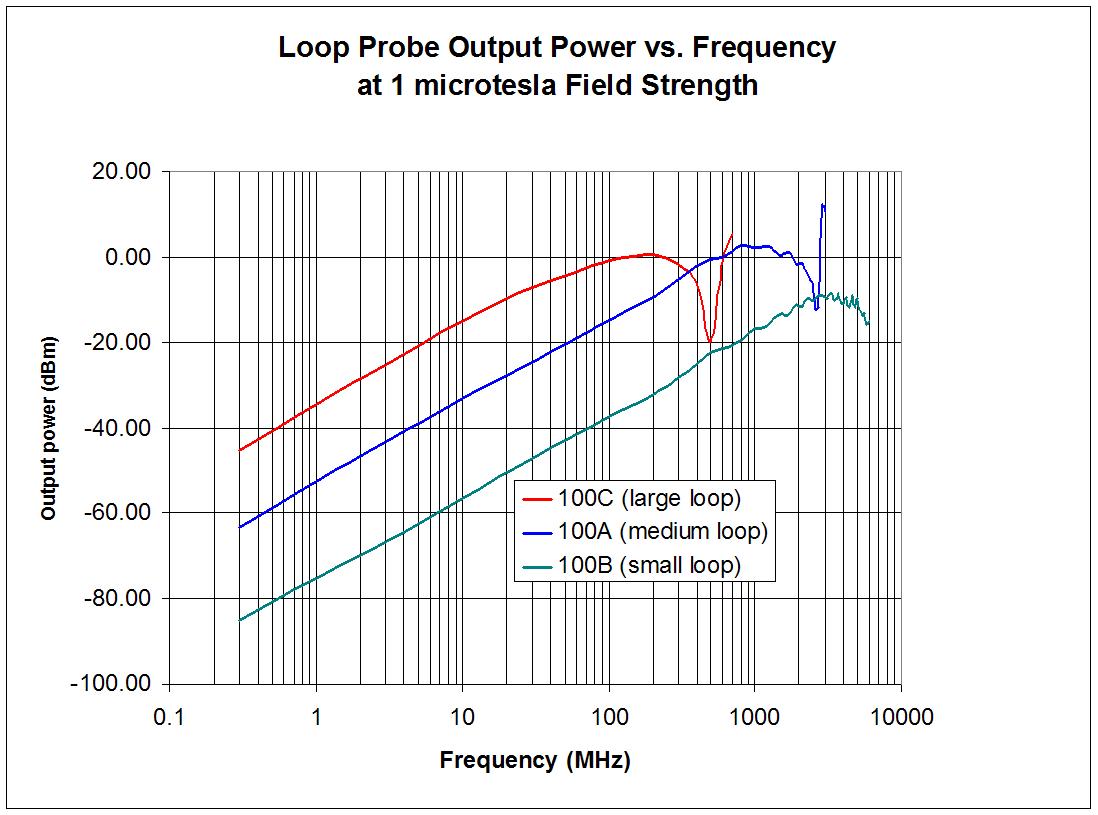
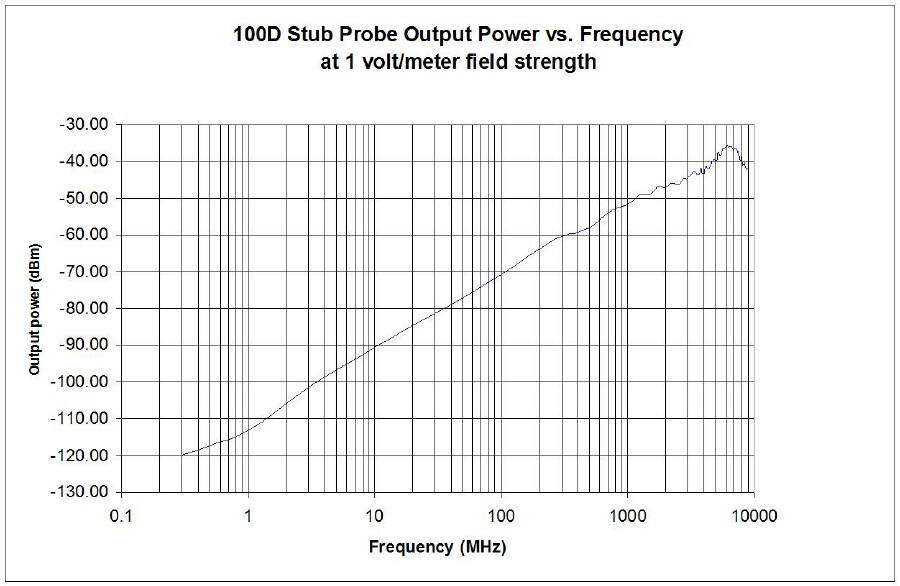
The following curves show the measured output power of each probe into 50 ohms for a 1 uT rms field (without pre-amplifier).  This can also be computed from the equations below the figures.
Frequency Response of the Loop Probes
Frequency Response of the Electric Field Probe
Frequency Response of the Loop Probes
Frequency Response of the Electric Field Probe
Equations for Frequency Response and Sensitivity:

Loop Probes (EMC-100A/B/C): The equation below for Output Power is plotted in the loop probe graph above, and is accurate to within ± 3 dB at frequencies from DC to the 3 dB frequency  shown in the table below for each loop probe. The probes are usable to higher frequencies but the sensitivity is uncalibrated above the 3-dB frequency. The first notch in the frequency response of the probes occurs at the first resonance listed in this table.

Output Power = [X + 20*log10(B) + 20*log10(F)] dBm

Where   B is the rms magnetic flux density in Tesla, 
F is the frequency of the received signal in Megahertz
X is a scale factor from the following table:

Loop SizeX3-dB Frequency First Resonance
Large      85.1     50 MHz    500 MHz
Medium   67.1 1000 MHz  2600 MHz
Small      44.4 3100 MHz>6000 MHz


Electric Field Probe (EMC-100D): Stub probes tend to be less repeatable than shielded loop probes, due to the presence of common-mode currents flowing on the outer surface of the probe or attached cable. As signals are measured, it is common to see a few dB of variation in output power as the user changes their grip on the probe or the attached cable. Because of this, the sensitivity of the 100D is not guaranteed. Typical sensitivity of the Electric Field Probe is given by the following equation, and shown in the 100D figure above.

Output Power = [-113.2 + 20*log10(E) + 20*log10(F)] dBm

Where   E is the rms electric field strength, in Volts/meter
F is the frequency of the received signal in Megahertz

For Larger Graphs See Below
Probe Dimensions:
Length, excluding connector:  6.35" (161 mm)
Tip thickness:  0.11" (2.8 mm) can be inserted into seams and gaps
Tip diameter:  Stated above next to photos.
Connector: SMB male, 50 ohms  (adapters also available, see below).
Amplifier
Email for details

$525.
In stock