Is there scientific evidence of adverse health effects due to AC magnetic fields? Yes. Researchers have found health effects, including a doubling of leukemia rates associated with living in AC magnetic field strengths greater than 4.0 mG [4mG = 0.4uT]
The Swedish National Energy Department issued an advisory warning that schools, playgrounds, and day-care centers should not be sited near power lines, and that children should not be subjected for long periods every day to AC magnetic fields over 3.0 mG. [3mG = 0.3uT].
The Baubiologie Institute recommends 1 mG maximum exposure to AC magnetic fields for sleeping areas. Also a scientific panel recommended 1mG exposure limit based on risk for leukemia, brain tumors, Alzheimer‘s, ALS, sperm damage and DNA strand breaks [1mG = 0.1uT]. The Bioinitiative Report has similar guidelines. These recommendations are for long-term continued exposure for many hours and days, not to brief exposures like driving under power lines.
The main sources of AC magnetic fields are: power lines, appliances, wiring in floors and walls, or improperly wired homes. In many homes it is possible to reduce exposure by relocating beds, work, and play areas to where AC fields are below 1.0 mG.
Define "EMFs", Hz, kHz, AC, ELF, RF: EMFs are “Electromagnetic Fields”, as defined here by NIH_National Cancer Institute and CDC. (Another definition of EMF not needed here but used in Physics is "Electromotive Force")
"Hz" is “Hertz” is the frequency per second of EMF oscillations: 60 Hz means 60 waves per second.
"kHz" is thousands of waves per second. "MHz" =millions per sec. "GHz" = billions per sec.
"AC" is "Alternating Current" which is the electrical power (at 60 Hz and 50 Hz) used in homes and buildings.
“AC magnetic fields” are the type of EMF described on this web page, it's produced by AC currents in appliances, houses, power lines, and it's measured with an AC Gaussmeter.
"ELF" means “Extremely Low Frequency” which are EMFs oscillating at frequencies from 1 Hz to 3 kHz (includes AC frequencies): www.osha.gov/elf-radiation/standards
"RF" is “Radio Frequency” which are EMFs oscillating at 3 kHz to 300 GHz, from mobile phones, cell towers Wi-Fi routers, etc. For information on RF type of EMFs see RF Exposure.
For more information on different types of EMFs scroll to bottom of this web page.
What are mG and uT? These are units of magnetic field strength: 1 uT = 10 mG. mG is “milligauss” and uT is “microtesla.” Measured using a gaussmeter or teslameter.
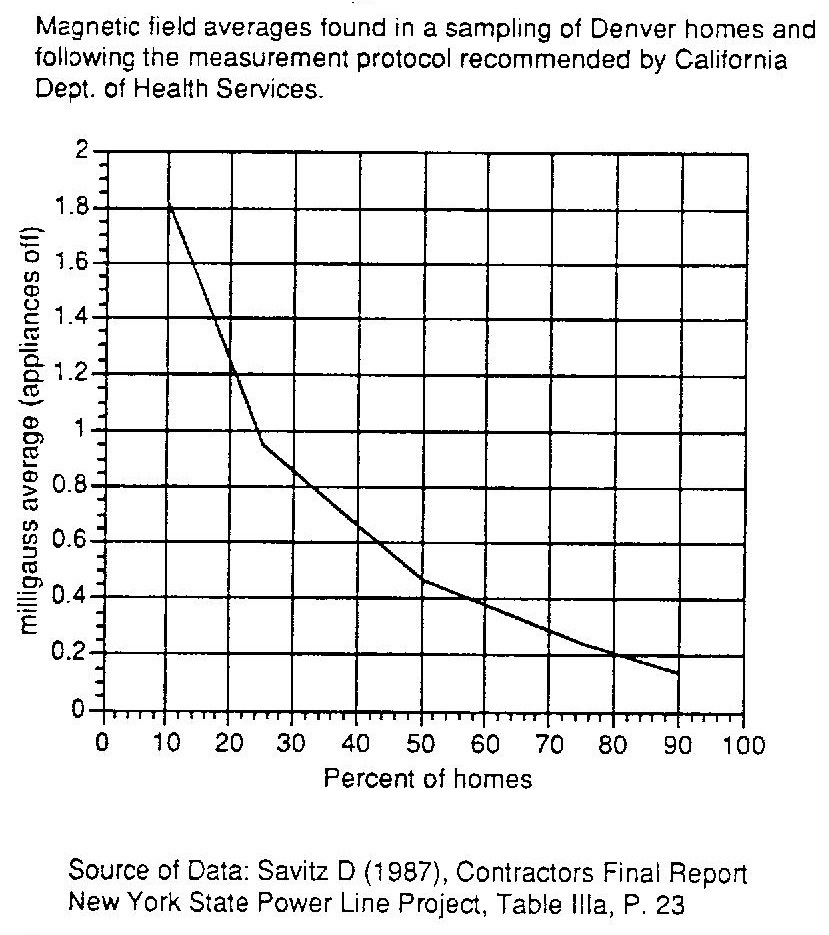
What is a typical AC magnetic field level in a home? Inside a typical house usually measures about 0.3 to 1.0 mG as seen in the graph below (measured in the middle of the rooms, not very close to appliances or wiring, it shows about 75% of homes averaged less than 1 mG). Apartments and condos are a bit higher. Beds and play areas can be located where the fields are low, for example below 1.0 mG. You can measure AC magnetic fields in a home or workplace using an AC gaussmeter.
Why are AC magnetic fields much higher in some houses? Proximity to power lines, or to transformers at top of some phone poles, often increase fields close by. But the most common reason some houses measure much higher AC fields is improper wiring and grounding connections within the house which were not wired according to the National Electrical Code (NEC). This problem is more common in older houses that have been re-wired or remodeled. Improper grounding can result in unbalanced currents which cause high AC magnetic fields, usually over a large part of the house. All the outlets and appliances usually still work fine, and the magnetic fields are invisible. To test a house, it is more accurate to turn ON all the lights and appliances that would normally be on while living there. If the gaussmeter shows high fields, then turning off some appliances, or the main circuit breaker for the entire house, can show whether the high fields are coming from the house wiring. Locating and fixing wiring errors can be very time consuming and expensive, we offer a book and DVD to help electricians with this.
Why do some locations within a house measure higher AC magnetic field levels? Due to nearby appliances or wires in the walls or floor, the readings may vary, depending on appliances in use and the location tested. Some appliances that emit high fields could be moved away from beds. High fields very close to walls, floors, or ceilings are often due to cabling or wires in walls or floors. Close to the electrical panel and “drop line” usually shows especially high fields, since electricity to the entire house passes through there. (The "drop line" is the thick cable bringing power from the street to the electric meter and it's often on a wall on the outside of the house). Magnetic fields go through walls, so a bed or pillow or work or play area could be exposed to high fields within a few feet of the drop line or other cabling behind walls. Beds and places where people spend a lot of time could be moved to where fields are lower. Other electric cables in walls or floors that carry large currents can also produce high magnetic fields, especially in large buildings like apartments, offices, and dormitories. Fuse boxes (circuit breakers), electric meters, and transformer boxes also produce high fields, which can pass through walls.
Power lines: Proximity to an overhead power transmission line increases AC magnetic fields, sometimes up to hundreds of feet away. Exposure will depend on distance, size of power line, and the amount of current carried on the power line which may vary seasonally or with time of day, sometimes powerlines are turned off or operate at reduced power. A distance of 100 meters away from a large overhead 400 kV Transmission power line should be far enough away to reduce the AC magnetic field to 1 milligauss, according to this technical paper: “Magnetic Fields from Transmission Lines: Comparison of Calculations and Measurements,” J. Swanson, IEE Proceedings on Generation Transmission and Distribution, Vol.142, No.5, September 1995. Also, using a gaussmeter you could check the AC magnetic fields near the power lines, then walk away and the field should decrease as you get farther away from the power lines, and where the reading stops decreasing or starts increasing, that is likely due to other closer sources of magnetic fields, like houses or a transformer at top of a phone pole, or wire between phone poles, or you may have reached the minimum field that your gaussmeter can measure (usually about 0.2 - 0.4 mG).
Government limits for AC Magnetic Field exposure: The USA has no federal legal limits for exposure to 60 Hz magnetic fields. Two US states limit public exposure near overhead power lines to 150 mG (Florida) or 200 mG (NY) www.nvenergy.com/safety/understanding-emf Standards from ICNIRP allow 830 mG exposure of the public. This site outlines government guidelines: www.osha.gov/elf-radiation
How can AC magnetic fields be reduced? There is no practical affordable way to shield 60 Hz magnetic fields in homes. Most RF shielding materials (aluminum siding, foil, conductive fabric, etc) work at RF but do not block AC magnetic fields. More realistic options that may help to reduce 60 Hz AC magnetic fields are: fixing wiring errors (if that's the problem), choosing locations with lower fields to spend a lot of time (beds, pillows, work & play areas, etc), moving or turning off appliances that cause prolonged high field exposure, turning off lights and appliances at night, or in extreme cases turning off some fuses at night.
The 60 Hz magnetic fields are not coupled to the electric field (since they’re near field) so this magnetic field is not blocked by aluminum or other non-ferromagnetic metals. Even ferromagnetic materials like steel needs to be at least 1 cm thick (3/8 inches) to block much of the 60 Hz magnetic field. Or use very expensive special magnetic shielding materials. So its not practical to shield a residence.
Why do we recommend triple-axis gaussmeters? For checking AC magnetic fields, triple-axis AC Gaussmeters like the Bell-4180 are easier to use, much faster, and therefore result in more accurate measurements. Single-axis gaussmeters like PF5 need to be rotated in various directions which is slow and often results in reduced accuracy due to not rotating it to show the maximum field.
Induction hobs use VLF magnetic fields to induce high currents in iron and steel pans which then internally heat the metal. They are very energy-efficient, but some of the VLF fields leak out around the base of the pan and expose the person doing the cooking. A 2012 study that measured 16 induction hob units found that most could exceed even the very high ICNIRP levels. The PF5 meter measures those VLF magnetic fields.
The Earth’s magnetic field is safe: Yes, it is a safe static magnetic field which people have lived in for millions of years. It is not the same as AC magnetic fields from AC electricity, which came into widespread use about 100 years ago.
Can the AC gaussmeters measure magnets or the Earth's magnetic field? No, they do not measure static magnetic fields. Magnetometers or DC Gaussmeters can measure magnets.
What types of EMFs are there? “EMFs” usually refers to one or more of the following:
(a) AC magnetic fields (Low Frequency, ELF/VLF) from building wiring, appliances, and power lines. These are described on this web page.
(b) Radio Frequency (RF) electromagnetic fields, which are described on our page about RF fields.
(c) EMFs may also include the electric fields at AC frequencies like 50 Hz or 60 Hz or other much lower frequencies than RF "Radio Frequencies".
(d) Dirty Electricity is higher-frequency voltage transients (electrical noise) riding on the 50 Hz or 60 Hz power wiring in your home or building www.nature.com/articles/jes20108
What units are usually used to measure these electromagnetic fields (EMFs)?
For (a): AC Magnetic field in milligauss (mG) or microtesla (uT) (1 mG = 0.1 uT).
For (b): RF field in V/m or Watts per square meter (W/m2), mW/m2, uW/m2 or similar units.
For (c): AC Electric field in Volts per meter (V/m).
What meter can measure it?
For (a) use an AC gaussmeter.
For (c) use the PF5 Magnetic and Electric Field Meter, or the Electric Field Sensor. The electric field is difficult to measure accurately since it is changed by many nearby objects including the body of the person making the measurements. The electric field is reduced by wood, brick, and aluminum walls. Experts at EMField Solutions believe that the magnetic field is the main concern, more so than the electric field.
For (d) use a "Dirty Electricity" meter or Broadband EMI meter.
What is maximum EMF exposure recommended for long periods of time? Expert opinion varies, here are some cautious estimates:
For (a) 1.0 mG max. See near top of this page.
For (b) 10 uW/m2 max. See www.magneticsciences.com/RF-health/
For (c) 1.5 V/m max is recommended by Baubiologie for sleeping quarters at AC frequencies (like 50 Hz or 60 Hz). Or if someone has a pacemaker or other electrically sensitive implants then 1.0 V/m max is recommended. Germany and IRPA/INIRC recommend maximum electric field of 5 V/m for the public, 10 V/m for workers, and 25 V/m for workers up to 2 hours. Some other researchers recommend 10-20 V/m max in homes and offices, and 5 V/m max for sleeping areas.
For Disclaimers see Terms and Conditions
© 2025 Magnetic Sciences Inc.